
PNGX Equities • Fixed Income • Investor Education
A very quiet week: turnover K0.17m
Just four counters change hands
JMP Weekly Report | Week ending 2 October 2026
| TRADING VALUE K0.17m −94% on prior week |
TOTAL VOLUME 30,844 −97% on prior week |
STOCKS TRADED 4 of 11 BSP, KSL, KAM, CCP |
MARKET YIELD (LTM) 5.28% flat wow |
Weekly Trade Commentary
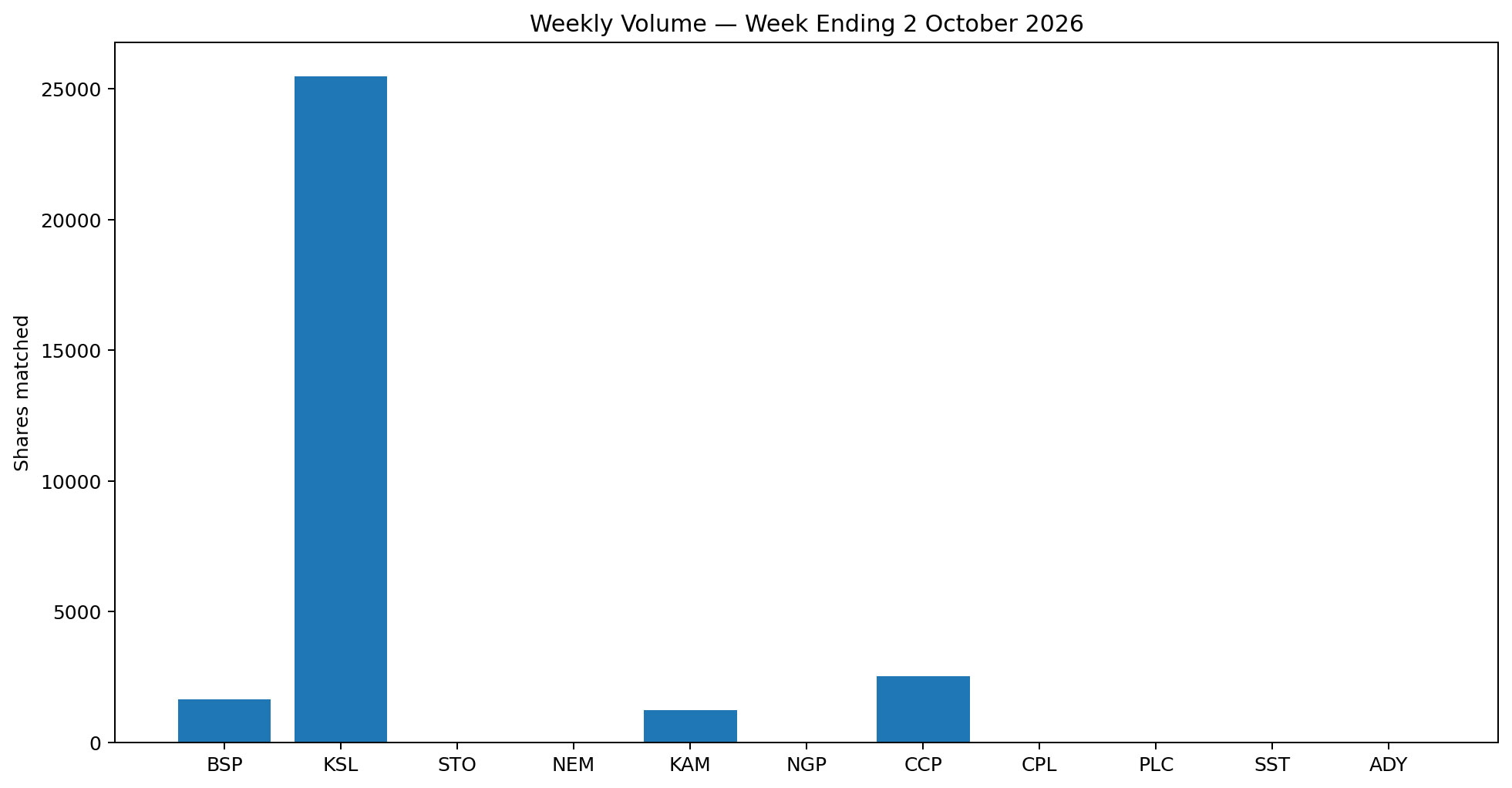
A near-dormant week — turnover collapsed to just K0.17m on 30,844 shares as only four counters traded. BSP managed 1,628 shares (steady at K27.95); KSL was the most active at 25,492 shares but fell 20t to K4.10; KAM traded 1,210 shares steady at K2.25 and CCP 2,514 steady at K4.66. Newly-listed ADY again placed an opening bid of K1.25 without trading; STO, NEM, NGP, CPL, PLC and SST were all untraded.
| Stock | Volume | Close (K) | Value (K) | Change | Change % |
|---|---|---|---|---|---|
| BSP | 1,628 | 27.95 | 45,502.60 | — | — |
| KSL | 25,492 | 4.10 | 108,399.12 | −0.20 | −4.65% |
| STO | — | 22.90 | — | — | — |
| NEM | — | 490.00 | — | — | — |
| KAM | 1,210 | 2.25 | 2,722.50 | — | — |
| NGP | — | 1.36 | — | — | — |
| CCP | 2,514 | 4.66 | 11,715.24 | — | — |
| CPL | — | 1.10 | — | — | — |
| PLC | — | 1.48 | — | — | — |
| SST | — | 50.00 | — | — | — |
| ADY | — | — | — | — | — |
| TOTAL | 30,844 | 168,339.46 | −0.06% |
Source: PNGX matched on-market trades, week ending 2 October 2026. JMP Securities analysis.
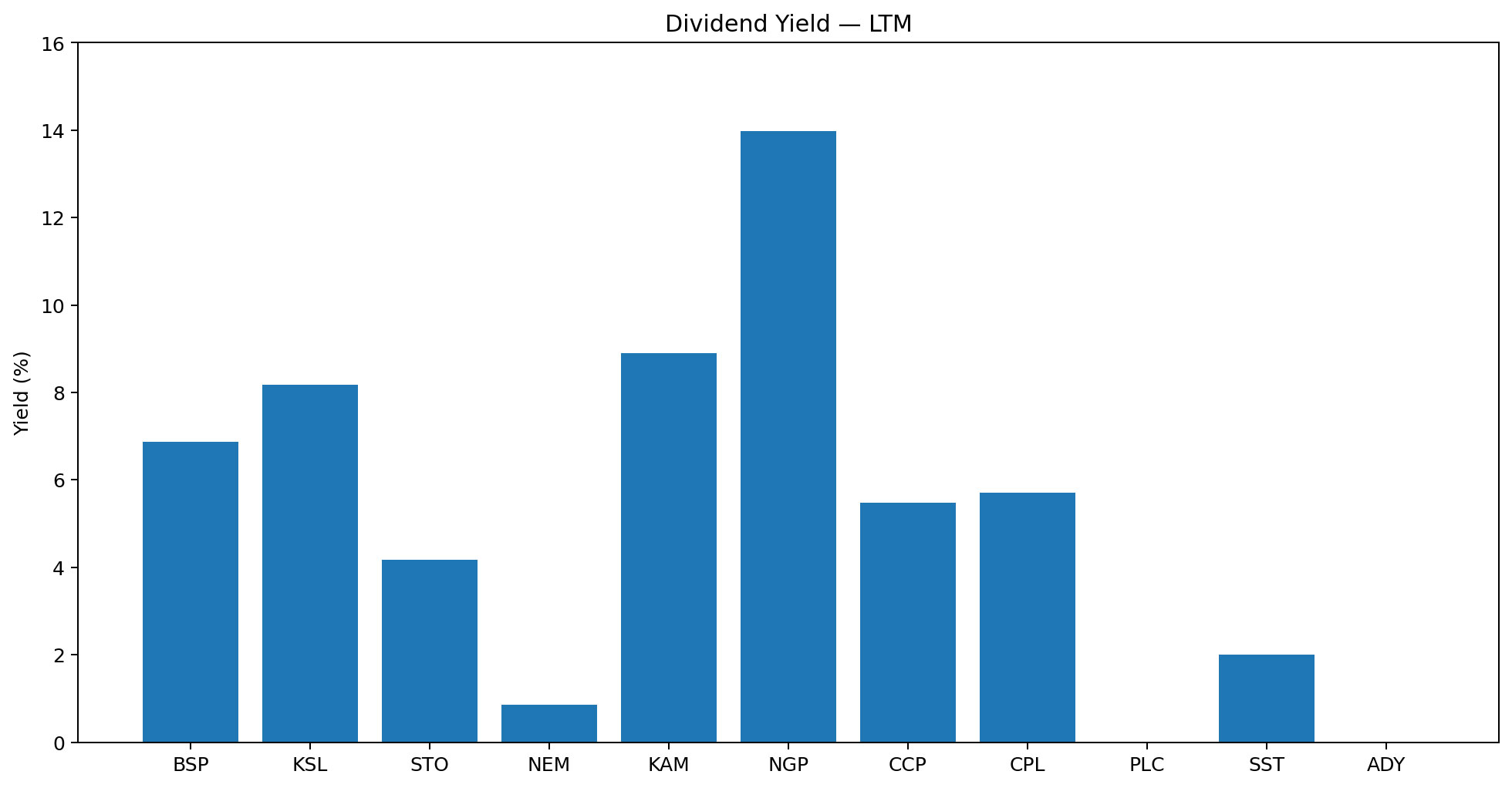
Dividend Yield
Market-wide LTM dividend yield held at 5.28% this week (weighted by market cap, legacy methodology). KSL firms further to 8.17% as its price slipped to K4.10; the rest of the board is unchanged. NGP (13.97%) still leads, then KAM (8.89%), KSL (8.17%) and BSP (6.87%). PLC remains pre-dividend; newly-listed ADY has no dividend history yet.
| Stock | Issued Shares | Mkt Cap (K) | Fin 24 | Int 25 | Fin 25 | Int 26 | Yield % |
|---|---|---|---|---|---|---|---|
| BSP | 467,317,665 | 13,061,528,737 | 1.210 | 0.500 | 1.380 | 0.540 | 6.87% |
| KSL | 294,332,296 | 1,206,762,414 | 0.155 | 0.126 | 0.193 | 0.142 | 8.17% |
| STO | 3,261,616,703 | 74,691,022,499 | 0.414 | 0.559 | 0.443 | 0.514 | 4.18% |
| NEM* | 1,097,000,000 | 537,530,000,000 | — | 2.110 | 2.110 | USD $0.520 | 0.86% |
| KAM | 53,259,588 | 119,834,073 | — | 0.250 | — | 0.200 | 8.89% |
| NGP | 45,890,700 | 62,411,352 | 0.120 | 0.040 | 0.190 | — | 13.97% |
| CCP | 307,931,332 | 1,434,960,007 | 0.121 | 0.121 | 0.130 | 0.125 | 5.47% |
| CPL | 206,277,911 | 226,905,702 | — | 0.050* | 0.040 | 0.020 | 5.71% |
| PLC | 860,718,662 | 1,273,863,620 | — | — | — | — | — |
| SST | 31,008,237 | 1,550,411,850 | 0.300 | 0.400 | 0.650 | 0.350 | 2.00% |
| ADY | 316,766,640 | — | — | — | — | — | — |
| TOTAL / WEIGHTED-AVG | 5.28% |
LTM = Last twelve months. Yields use most recently declared interim and final dividends. NEM dividends in USD until PGK rate announced; NEM excluded from market-wide yield. PLC now added.
Dividend Yield = Annual Dividends per Share ÷ Current Share Price × 100
Key Market Announcements
A quieter announcements board. ADY granted options and RSUs; PLC called its AGM (with director nominations) and lodged its FY2026 annual financial report — signalling it remains listed; NEM scheduled its Q3 2026 results call and lodged two Form 144 filings; and KSL filed an Appendix 10B on a change in directors’/CEO’s interests.
| Stock | Announcement | Source |
|---|---|---|
| ADY | Adyton grants options & RSUs | View announcement >> |
| PLC | AGM & nomination of directors; FY2026 annual financial report | View announcement >> |
| NEM | Q3 2026 results conference call; Form 144 filings (Viljoen, Toth) | View announcement >> |
| KSL | Appendix 10B — change in directors’ / CEO’s interests | View announcement >> |
Source: PNGX market announcements, 28 September – 2 October 2026.
BPNG Treasury Bill Auction
Auction: 30-SEP-26 / GOI / Government Treasury Bill | Settlement: 02-OCT-26 | Amount on offer: K270.0m
| Terms | Issue / 63 | Issue / 91 | Issue / 182 | Issue / 273 | Issue / 364 | Total |
|---|---|---|---|---|---|---|
| Weighted Avg Yield | — | — | 4.64% | 5.04% | 5.04% | |
| Amount on Offer (K’m) | — | — | 20.00 | 50.00 | 200.00 | 270.00 |
| Bids Received (K’m) | — | — | 35.40 | 65.00 | 269.09 | 369.49 |
| Successful Bids (K’m) | — | — | 20.00 | 50.00 | 200.00 | 270.00 |
| Over / (Under) Subscribed (K’m) | — | — | +15.40 | +15.00 | +69.09 | +99.49 |
Source: Bank of Papua New Guinea — Domestic Markets Department, T-Bill auction 30 September 2026 (settlement 2 October 2026).
BPNG Government Bond Auction
NO NEW ISSUANCE — WEEK ENDING 2 OCTOBER 2026
Auction: 22-SEP-26 / GOB / Government Bond | Settlement: 25-SEP-26 | Amount on offer: K300.0m
| Series | Offer | Bids | Successful | Yield | Weighted Avg | Coupon | Net Subscription |
|---|---|---|---|---|---|---|---|
| 2026/5057 — 3 yr | 50.00 | 60.00 | 55.00 | 6.17–6.20% | 6.18% | 6.20% | +10.00 |
| 2026/5058 — 5 yr | 50.00 | 66.10 | 66.10 | 6.50–6.60% | 6.57% | 6.57% | +16.10 |
| 2026/5059 — 7 yr | 50.00 | 112.20 | 112.20 | 6.60–6.70% | 6.68% | 6.70% | +62.20 |
| 2026/5060 — 10 yr | 100.00 | 126.54 | 110.54 | 6.70–6.80% | 6.77% | 6.80% | +26.54 |
| 2026/5061 — 15 yr | 50.00 | 56.00 | 50.00 | 7.17–7.20% | 7.18% | 7.20% | +6.00 |
| TOTAL | 300.00 | 420.00 | 393.00 | +120.84 |
Source: Bank of Papua New Guinea — Domestic Markets Department, GOB auction 22 September 2026 (settlement 25 September 2026).
Investor Education: Repurchase Agreements (Repo)
What is a repo?
A repo (repurchase agreement) is a sale of securities today with a binding agreement to buy them back later at a higher price. Economically it is a short-term loan secured by collateral: the seller borrows cash, while the buyer lends cash and holds the securities as security until repaid. The gap between the sale price and the repurchase price is the interest — expressed as an annual rate, the repo rate. Every repo is a “reverse repo” seen from the counterparty’s side.
A trade has two legs. On day one (the near leg) the cash borrower delivers collateral — usually government bonds or bills — and receives cash equal to its market value less a “haircut” (a buffer against price falls). At maturity (the far leg) the same securities are returned, and the cash is repaid with repo interest. A simple 30-day kina example: K10m of stock at a 2% haircut funds K9.8m of cash; at a 5% repo rate the borrower repays K9,840,274 — about K40,274 of interest.
Repos come in several forms — bilateral, tri-party (an agent holds and values the collateral) and centrally cleared (a CCP nets exposures) — and are priced on general collateral (any bond from a basket; the trade is about the cash) or “special” (demand for one specific bond). Key risks are counterparty default, collateral-value falls and rollover risk when funding dries up — as in 2007–08, when haircut hikes and funding withdrawals turned solvency doubts into liquidity runs, and the September 2019 US repo spike that briefly pushed overnight rates near 10%. Central banks use repos to add liquidity and reverse repos to drain it.
| 01 | Collateral Usually government bonds or bills — sometimes corporate bonds or equities — posted as security for the cash. |
| 02 | Repo rate The annualised interest on the cash leg, agreed upfront: the gap between the sale and repurchase price. |
| 03 | Haircut Cash lent is less than the collateral’s market value — a buffer protecting the lender if prices fall. |
| 04 | Tenor Overnight, a fixed term of days to months, or open until either side ends the trade. |
What We’ve Been Reading

FEATURED READ
How anti-avoidance rules are reshaping tax competition
IMF Blog • Beltran Saavedra, Fujii, Kindberg-Hanlon & Ladreit
Highly mobile intangibles — data, patents, software, trademarks — have let multinationals report profits far from where they actually do business, shifting them to low-tax locations, while governments competed by cutting rates and offering incentives. The IMF finds that is now changing. As anti-avoidance rules spread, multinationals increasingly report profits where they invest: reported profits have become less sensitive to tax-rate differences, and real investment more sensitive. Tax competition is shifting from attracting profits to luring the activity that generates them.
Competition hasn’t vanished, but its character has changed. A 1-point cut in other countries’ headline rates is associated with a 0.4-point cut at home on average — strongest among economies at similar development stages — but since the mid-2010s that headline-rate competition has moderated, alongside stronger anti-base-erosion reforms. The spillovers matter: corporate-tax cuts in major economies are followed by lower output elsewhere (capital reallocation outweighs import demand), and a 1-point rise in a country’s rate relative to others cuts FDI inflows by about 0.5% of GDP over three years.
JMP read: The read-through for PNG sits in the last finding. The IMF stresses that anti-avoidance measures, by limiting profit-shifting, preserve fiscal space — and that the gains are largest for emerging and developing economies that lean heavily on corporate-income-tax revenue to fund infrastructure, health and education. PNG is squarely in that group: a resource economy where protecting the corporate tax base directly supports the budget and the development spending behind long-run growth. The signal is less about chasing headline-rate cuts than about collecting the tax genuinely owed.
Figure — Tax Competition Spillovers
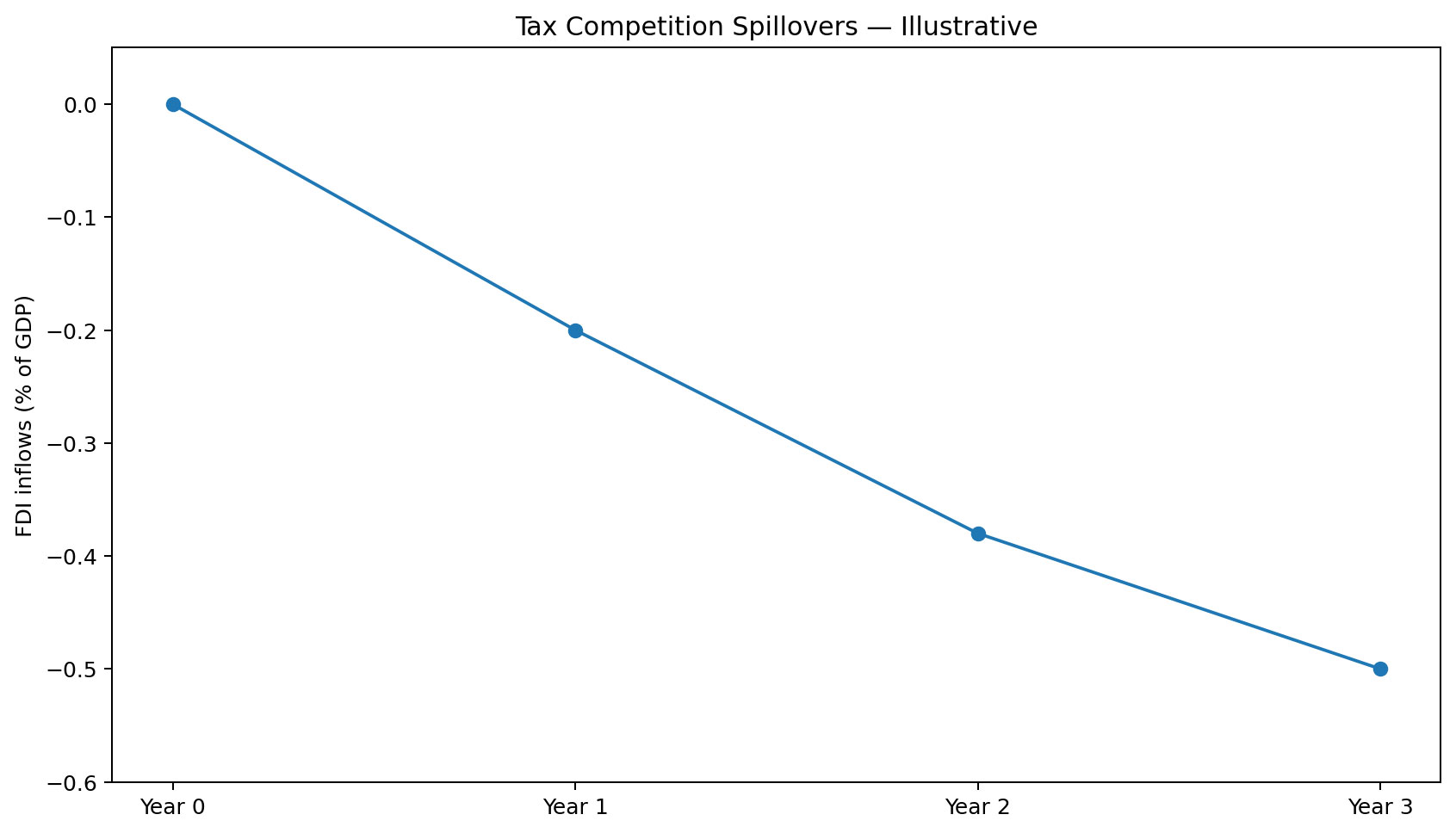
Source: IMF (Beltran Saavedra et al.); JMP illustration. Illustrative: a 1pp rise in a country’s corporate tax rate relative to peers is associated with ~0.5% of GDP lower FDI inflows cumulatively over three years.
Also on our desk
- Anti-avoidance rules are spreading — multinationals increasingly report profits where they actually invest — IMF
- Reported profits are now less sensitive to tax rates; real investment more sensitive — IMF
- Anti-avoidance preserves fiscal space, with the largest gains for emerging and developing economies — IMF
What this report covered this week
- Weekly trade activity — 4 stocks traded, K0.17m value (−94% pw); a very quiet week
- Dividend yields — market-wide LTM 5.28% (flat; KSL firms to 8.17%)
- ADY options/RSUs; PLC AGM & annual report; NEM Q3 call; KSL director interests
- BPNG T-Bill auction — over-subscribed by K99.49m
- BPNG bond auction — most recent (no new issuance this week)
- Investor Education — Repurchase Agreements (Repo)
- External research — IMF on tax-avoidance rules & tax competition
For Further Enquiries
Speak to your equities trader for any orders, research questions or market colour.
Benny Takin
Equities Trader — Primary contact, JMP Weekly Report
benny.takin@jmpmarkets.com
+675 7001 9121 / 320 0240
JMP Securities Limited
Level 3, ADF Haus, Musgrave Street
PO Box 2064, Port Moresby NCD, Papua New Guinea
Disclaimer
This report has been prepared by JMP Securities Limited (Capital Market Licence holder, Securities Commission of PNG). It is general information only and does not take into account the objectives, financial situation or needs of any particular person. It is not an offer or solicitation to buy or sell any security. Information is sourced from PNGX, Bank of Papua New Guinea and external publications cited herein, with JMP analysis. While reasonable care has been taken, no warranty is given as to accuracy or completeness; to the maximum extent permitted by law JMP accepts no liability for loss arising from reliance on this material. Investors should obtain independent professional advice before making any investment decision.