
PNGX Equities • Fixed Income • Investor Education
BSP block lifts turnover to K8.42m
Just four counters change hands
JMP Weekly Report | Week ending 18 September 2026
| TRADING VALUE K8.42m +151% on prior week |
TOTAL VOLUME 312,688 +31% on prior week |
STOCKS TRADED 4 of 10 BSP, KSL, KAM, CCP |
MARKET YIELD (LTM) 5.28% −3 bps wow |
Download PDF >>
Weekly Trade Commentary
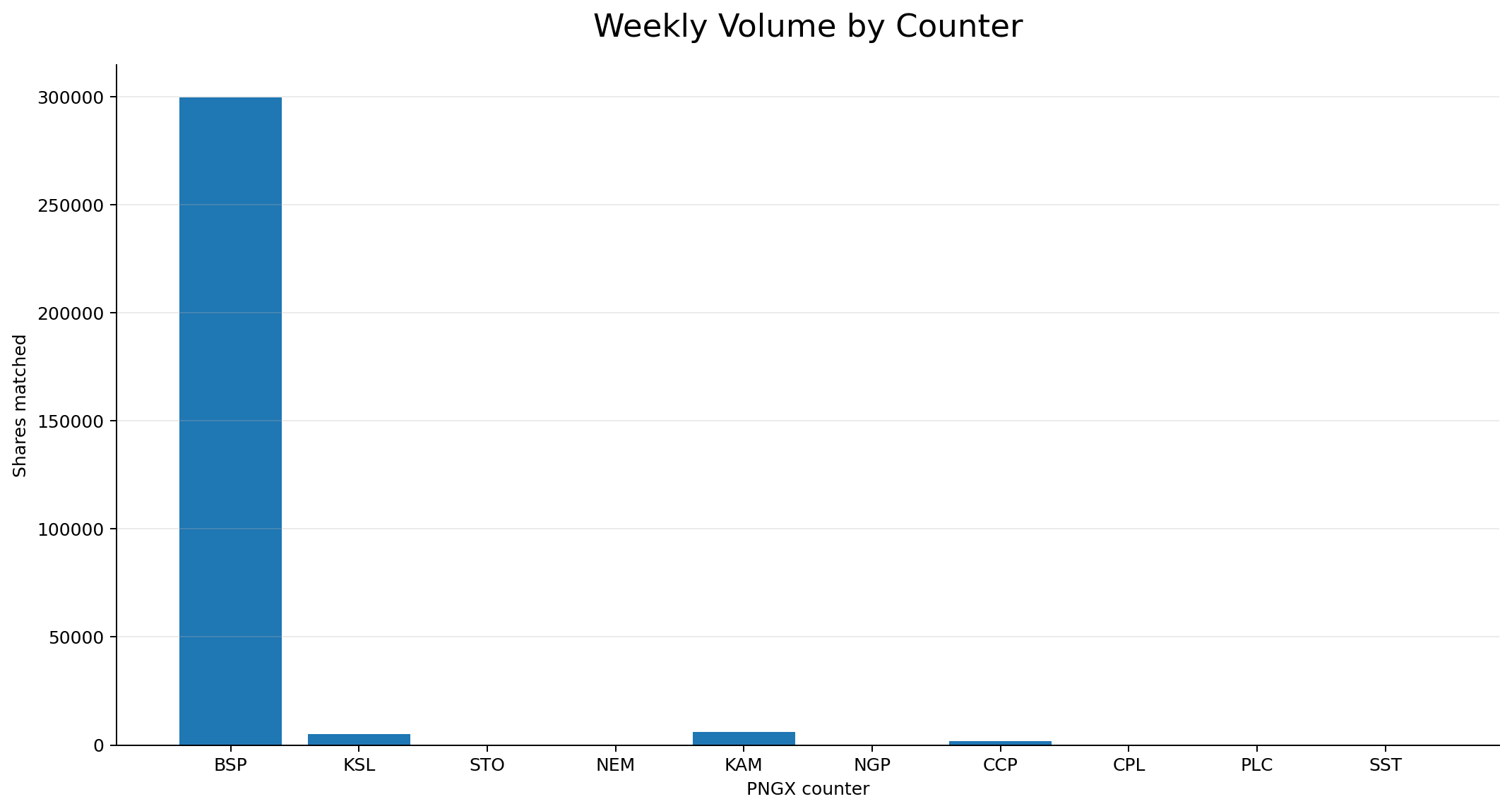
BSP dominated a thin tape — turnover rose to K8.42m on 312,688 shares, but only four counters traded and BSP alone was K8.38m of the value (299,827 shares, steady at K27.95). KSL eased 3t to K4.41 on 5,032 shares, KAM traded 6,163 shares steady at K2.25, and CCP 1,666 shares steady at K4.66. STO, NEM, NGP, CPL, PLC and SST did not trade.
| Stock | Volume | Close (K) | Value (K) | Change | Change % |
|---|---|---|---|---|---|
| BSP | 299,827 | 27.95 | 8,380,164.65 | — | — |
| KSL | 5,032 | 4.41 | 22,252.83 | −0.03 | −0.68% |
| STO | — | 22.90 | — | — | — |
| NEM | — | 490.00 | — | — | — |
| KAM | 6,163 | 2.25 | 13,866.75 | — | — |
| NGP | — | 1.36 | — | — | — |
| CCP | 1,666 | 4.66 | 7,763.56 | — | — |
| CPL | — | 1.05 | — | — | — |
| PLC | — | 1.48 | — | — | — |
| SST | — | 50.00 | — | — | — |
| TOTAL | 312,688 | 8,424,047.79 | −0.01% |
Source: PNGX matched on-market trades, week ending 18 September 2026. JMP Securities analysis.
Dividend Yield
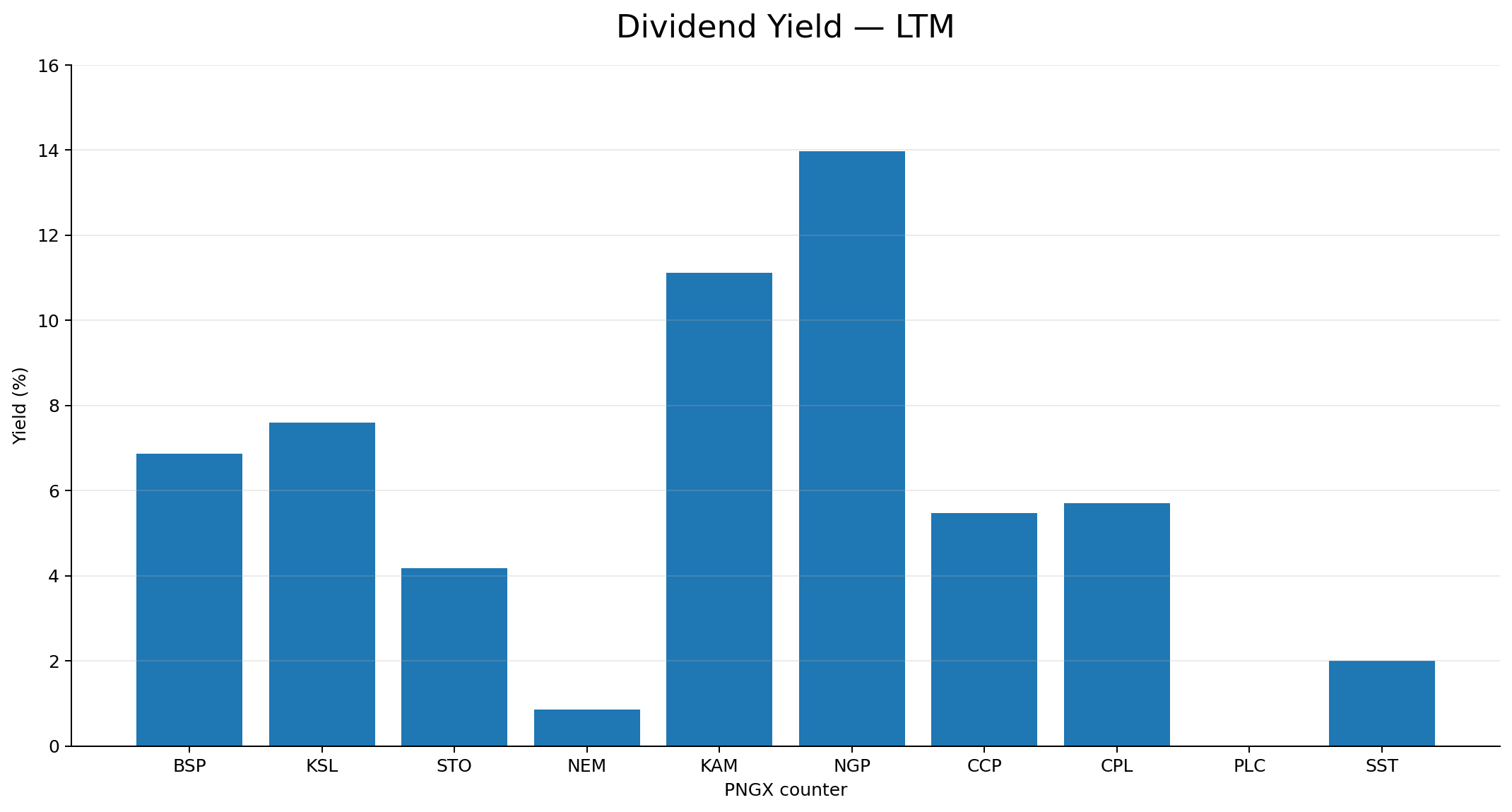
Market-wide LTM dividend yield held near 4.55% this week (weighted by market cap, legacy methodology). More names have now rolled 2026 interims into LTM: CCP firms to 5.47%, CPL steps down to 5.71% (its K0.02 interim replacing last year’s K0.05 in the window), and SST eases to 2.00%; KSL is 7.60%, STO 4.18%, BSP 6.87%. NGP (13.97%) still leads, then KAM (11.11%). PLC remains pre-dividend.
| Stock | Issued Shares | Mkt Cap (K) | Fin 24 | Int 25 | Fin 25 | Int 26 | Yield |
|---|---|---|---|---|---|---|---|
| BSP | 467,317,665 | 13,061,528,737 | 1.210 | 0.500 | 1.380 | 0.540 | 6.87% |
| KSL | 294,332,296 | 1,298,005,425 | 0.155 | 0.126 | 0.193 | 0.142 | 7.60% |
| STO | 3,261,616,703 | 74,691,022,499 | 0.414 | 0.559 | 0.443 | 0.514 | 4.18% |
| NEM* | 1,097,000,000 | 537,530,000,000 | — | 2.110 | 2.110 | USD $0.520 | 0.86% |
| KAM | 53,259,588 | 119,834,073 | — | 0.250 | — | — | 11.11% |
| NGP | 45,890,700 | 62,411,352 | 0.120 | 0.040 | 0.190 | — | 13.97% |
| CCP | 307,931,332 | 1,434,960,007 | 0.121 | 0.121 | 0.130 | 0.125 | 5.47% |
| CPL | 206,277,911 | 216,591,807 | — | 0.050* | 0.040 | 0.020 | 5.71% |
| PLC | 860,718,662 | 1,273,863,620 | — | — | — | — | — |
| SST | 31,008,237 | 1,550,411,850 | 0.300 | 0.400 | 0.650 | 0.350 | 2.00% |
| TOTAL / WEIGHTED-AVG | 5.28% | ||||||
*LTM = Last twelve months. Yields use most recently declared interim and final dividends. NEM dividends in USD until PGK rate announced; NEM excluded from market-wide yield. PLC now added.
*CPL Special Dividend 5t /share
Key Market Announcements
A results-heavy week. CCP, CPL and NGP all released their 2026 half-year results — with Appendix 5B financials, and an interim dividend notice from CPL. KSL lodged an Appendix 3A.1 dividend notification, and PNGX issued a public-holiday notice for Independence Day on 16 September.
| Stock | Announcement | Source |
|---|---|---|
| CCP | Half-Year 2026 Results (results, Appendix 5B, investor presentation) | View announcement >> |
| CPL | 2026 Half-Year Results (Appendix 5B) & interim dividend notice | View announcement >> |
| NGP | 2026 Half-Year Results & Appendix 5B | View announcement >> |
| KSL | Appendix 3A.1 — notification of dividend / distribution | View announcement >> |
| PNGX | Public Holiday Notice — Independence Day (16 September 2026) | View announcement >> |
BPNG Treasury Bill Auction
Auction: 15-SEP-26 / GOI / Government Treasury Bill | Settlement: 18-SEP-26 | Amount on offer: K270.0m
| Terms | Issue / 63 | Issue / 91 | Issue / 182 | Issue / 273 | Issue / 364 | Total |
|---|---|---|---|---|---|---|
| Weighted Avg Yield | — | — | 4.64% | 5.02% | 5.03% | |
| Amount on Offer (K’m) | — | — | 20.00 | 50.00 | 200.00 | 270.00 |
| Bids Received (K’m) | — | — | 22.11 | 50.55 | 220.20 | 292.86 |
| Successful Bids (K’m) | — | — | 22.11 | 50.55 | 200.00 | 272.66 |
| Over / (Under) Subscribed (K’m) | — | — | +2.11 | +0.55 | +20.20 | +22.86 |
BPNG Government Bond Auction
NO NEW ISSUANCE — WEEK ENDING 18 SEPTEMBER 2026
Auction: 18-AUG-26 / GOB / Government Bond | Settlement: 21-AUG-26 | Amount on offer: K480.0m
| Series | Offer | Bids | Successful | Yield | Weighted Avg | Coupon | Net Subscription |
|---|---|---|---|---|---|---|---|
| 2026/5057 — 3 yr | 50.00 | 60.00 | 50.00 | 6.10–6.27% | 6.26% | 6.30% | +10.00 |
| 2026/5058 — 5 yr | 100.00 | 118.00 | 100.00 | 6.43–6.70% | 6.61% | 6.70% | +18.00 |
| 2026/5059 — 7 yr | 80.00 | 85.00 | 80.00 | 6.73–6.80% | 6.76% | 6.80% | +5.00 |
| 2026/5060 — 10 yr | 150.00 | 180.00 | 150.00 | 6.73–6.90% | 6.84% | 6.90% | +30.00 |
| 2026/5061 — 15 yr | 100.00 | 120.00 | 50.00 | 7.13–7.30% | 7.26% | 7.30% | +20.00 |
| TOTAL | 480.00 | 563.00 | 480.00 | +83.00 |
Investor Education: High-Frequency Trading
High-frequency trading (HFT) is a sub-set of algorithmic trading defined by speed rather than by any view on value. Fully automated systems read exchange data feeds, decide, and submit or cancel orders in microseconds, aiming to capture fractions of a cent per share across enormous volumes. There is no single regulatory definition, but four attributes recur: microsecond decision-to-order latency, millions of orders submitted and cancelled daily, holding periods of seconds or less, and books run close to flat overnight.
The entire investment goes into shortening the loop between an event on the exchange and an order hitting the matching engine. Firms ingest raw, direct exchange feeds parsed in hardware; co-locate servers inside the exchange data centre with cable lengths equalised to the microsecond; fire pre-computed signals on book imbalance or correlated instruments; and post, amend or pull quotes — most messages are cancellations, not trades. Pre-trade risk limits and kill switches run in the same microsecond path.
Competitive edge is measured in nanoseconds and spent on infrastructure — microwave and laser links between data centres, FPGA network cards and exchange proximity fees — a fixed-cost arms race that concentrates the industry in a handful of private proprietary firms (Jane Street, Citadel Securities, Hudson River Trading, Jump, XTX, Virtu). HFT needs a continuous electronic order book, deep turnover, venue fragmentation and low tick size; it does not work in call-auction or broker-intermediated markets with thin turnover and wide spreads — which is why it is absent from a market like PNGX.
| 01 | Electronic market making Post simultaneous bids and offers, earn the spread and exchange rebates, and manage inventory continuously — the largest, most durable HFT revenue line. |
| 02 | Statistical arbitrage Exploit short-lived mispricings between correlated instruments — an ETF against its basket, a future against the cash index, a dual-listed stock against its other line. |
| 03 | Latency / cross-venue arbitrage Trade the same instrument across fragmented venues, acting on a price move at one before it reaches another — it depends entirely on being first. |
| 04 | Event & news-driven Machine-read economic releases, filings and headlines, traded in the milliseconds before discretionary participants can respond. |
What We’ve Been Reading
FEATURED READ
What governments should do when food prices surge
IMF Blog • Amaglobeli, Cerda, Mogues & Tumbarello
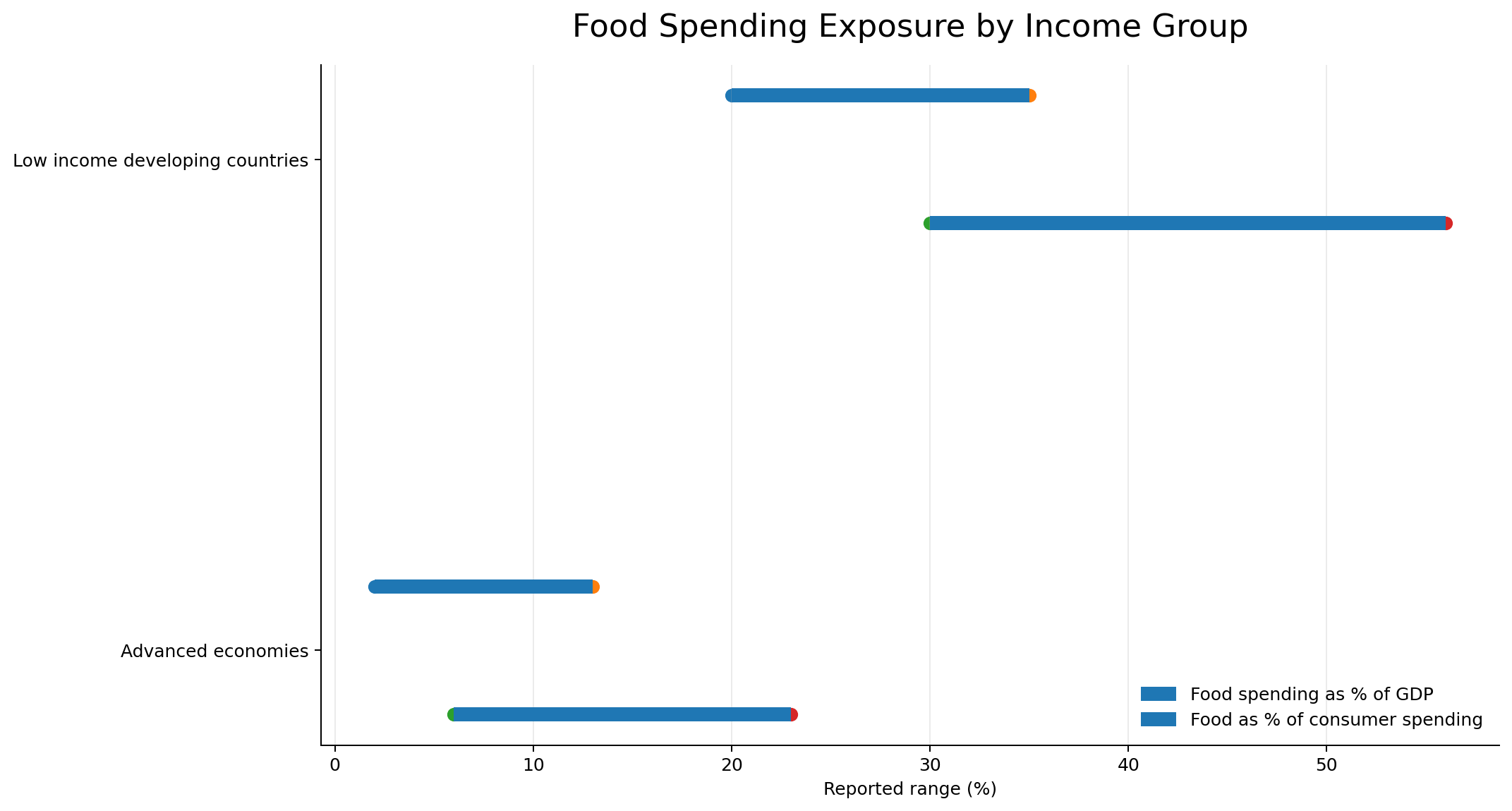
Food security for millions — especially low-income households — is under renewed pressure from two forces: the prospect of a strong or ‘super’ El Niño disrupting harvests, and an escalation of the Middle East war that could lift fertilizer and energy costs (some fertilizer prices already jumped almost 50% around planting season). When prices rise, governments face immediate pressure to act, because in many countries food is more than half of a family’s spending. The record is sobering: the 2015–16 El Niño hit food security for about 60 million people, and the 2022 price spike pushed roughly 71 million into poverty within three months.
The policy question is which tool to use — subsidize prices, distribute food directly, or provide vouchers — because the wrong choice wastes scarce resources while failing to protect the vulnerable. A new IMF framework poses four questions: is food available; is affordability the problem; are markets functioning; and can beneficiaries be targeted? Price subsidies are quick and need little targeting capacity but are costly and often benefit richer households; the IMF advises they be exceptional, temporary and tightly circumscribed. Vouchers target better where administrative capacity exists; direct in-kind transfers are essential when food is physically unavailable but are costly and can undercut local producers if run too long.
JMP read: The read-through for PNG is direct. As a commodity exporter and net food importer with a large subsistence population, PNG is exposed to El Niño harvest shocks and imported-food inflation, with little fiscal space to respond. The IMF’s discipline is the useful part: diagnose before acting, favor targeted, time-bound support over blanket subsidies, and build the targeting rails before the next shock — the food-and-fuel import bill stays a key swing factor for the kina.
Also on our desk
- A possible ‘super’ El Niño and a Middle East escalation are renewing global food-price pressure — IMF
- Four questions — availability, affordability, market function, targeting — pick the right tool — IMF
- Subsidies are quick but costly and poorly targeted; vouchers or in-kind aid often fit better — IMF
What this report covered this week
- Weekly trade activity — 4 stocks traded, K8.42m value (+151% pw)
- Dividend yields — market-wide LTM 5.28% (down 3bps; more 2026 interims rolled in)
- Results week — CCP, CPL & NGP half-year results; KSL dividend; Independence Day
- BPNG T-Bill auction — over-subscribed by K22.86m (all tenors covered)
- BPNG bond auction — most recent (no new issuance this week)
- Investor Education — High-Frequency Trading
- External research — IMF on food-price shocks
For Further Enquiries
Speak to your equities trader for any orders, research questions or market colour.
Benny Takin
Equities Trader — Primary contact, JMP Weekly Report
benny.takin@jmpmarkets.com
+675 7001 9121 / 320 0240
JMP Securities Limited
Level 3, ADF Haus, Musgrave Street
PO Box 2064, Port Moresby NCD, Papua New Guinea
Disclaimer
This report has been prepared by JMP Securities Limited (Capital Market Licence holder, Securities Commission of PNG). It is general information only and does not take into account the objectives, financial situation or needs of any particular person. It is not an offer or solicitation to buy or sell any security. Information is sourced from PNGX, Bank of Papua New Guinea and external publications cited herein, with JMP analysis. While reasonable care has been taken, no warranty is given as to accuracy or completeness; to the maximum extent permitted by law JMP accepts no liability for loss arising from reliance on this material. Investors should obtain independent professional advice before making any investment decision.