
PNGX Equities • Fixed Income • Investor Education
Turnover falls back to K4.25m
Five counters trade a quiet week
JMP Weekly Report | Week ending 23 October 2026
| TRADING VALUE K4.25m −90% on prior week |
TOTAL VOLUME 254,633 −89% on prior week |
STOCKS TRADED 5 of 11 BSP, KSL, CCP, CPL, PLC |
MARKET YIELD (LTM) 5.28% flat wow |
Weekly Trade Commentary
A quiet week after the BSP-block surge — turnover fell back to K4.25m on 254,633 shares as five counters traded. BSP led on value again (137,032 shares, K3.83m, steady at K27.95) and KSL was the busiest by volume (102,468 shares, easing 2t to K3.95). CPL traded 7,683 shares, PLC 6,635 and CCP 815, all steady. STO, NEM, KAM, NGP, SST and ADY did not trade.
| Stock | Volume | Close (K) | Value (K) | Change | Change % |
|---|---|---|---|---|---|
| BSP | 137,032 | 27.95 | 3,827,842.12 | — | — |
| KSL | 102,468 | 3.95 | 399,725.92 | −0.02 | −0.50% |
| STO | — | 22.90 | — | — | — |
| NEM | — | 490.00 | — | — | — |
| KAM | — | 2.25 | — | — | — |
| NGP | — | 1.20 | — | — | — |
| CCP | 815 | 4.66 | 3,797.90 | — | — |
| CPL | 7,683 | 1.10 | 8,451.30 | — | — |
| PLC | 6,635 | 1.47 | 9,753.45 | — | — |
| SST | — | 50.00 | — | — | — |
| ADY | — | — | — | — | — |
| TOTAL | 254,633 | 4,249,570.69 | −0.01% |
Weekly volume by counter (shares matched). BSP: 137,032; KSL: 102,468; CPL: 7,683; PLC: 6,635; CCP: 815. Source: PNGX; JMP Securities analysis.
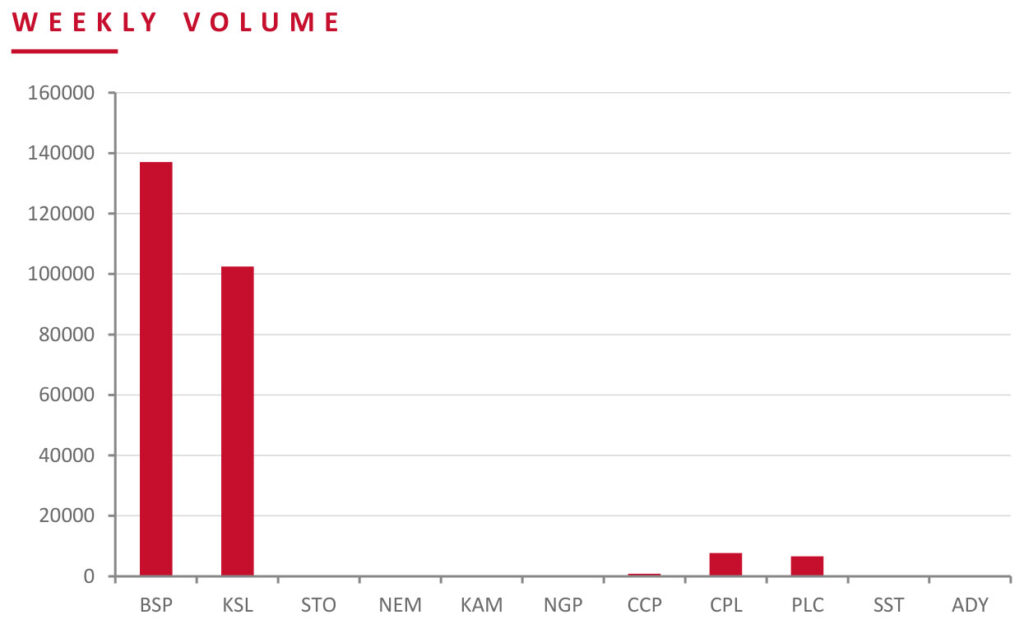
Source: PNGX matched on-market trades, week ending 23 October 2026. JMP Securities analysis.
Dividend Yield
Market-wide LTM dividend yield held at 4.55% this week (weighted by market cap, legacy methodology). KSL firms again to 8.48% on its slip to K3.95; the rest of the board is unchanged. NGP (15.83%) still leads, then KAM (8.89%), KSL (8.48%) and BSP (6.87%). PLC remains pre-dividend; ADY has no dividend history yet.
| Stock | Issued Shares | Mkt Cap (K) | Fin 24 | Int 25 | Fin 25 | Int 26 | Yield % |
|---|---|---|---|---|---|---|---|
| BSP | 467,317,665 | 13,061,528,737 | 1.210 | 0.500 | 1.380 | 0.540 | 6.87% |
| KSL | 294,332,296 | 1,162,612,569 | 0.155 | 0.126 | 0.193 | 0.142 | 8.44% |
| STO | 3,261,616,703 | 74,691,022,499 | 0.414 | 0.559 | 0.443 | 0.514 | 4.18% |
| NEM* | 1,097,000,000 | 537,530,000,000 | — | 2.110 | 2.110 | USD $0.520 | 0.86% |
| KAM | 53,259,588 | 119,834,073 | — | 0.250 | — | 0.200 | 8.89% |
| NGP | 45,890,700 | 55,068,840 | 0.120 | 0.040 | 0.190 | — | 15.83% |
| CCP | 307,931,332 | 1,434,960,007 | 0.121 | 0.121 | 0.130 | 0.125 | 5.47% |
| CPL | 206,277,911 | 226,905,702 | — | 0.050* | 0.040 | 0.020 | 5.45% |
| PLC | 860,718,662 | 1,265,256,433 | — | — | — | — | — |
| SST | 31,008,237 | 1,550,411,850 | 0.300 | 0.400 | 0.650 | 0.350 | 2.00% |
| ADY | 316,766,640 | — | — | — | — | — | — |
| TOTAL / WEIGHTED-AVG | 5.28% |
Trailing 12-month dividend yield by counter, as printed in the source report. Note: the KSL table and narrative figures differ in the source PDF.
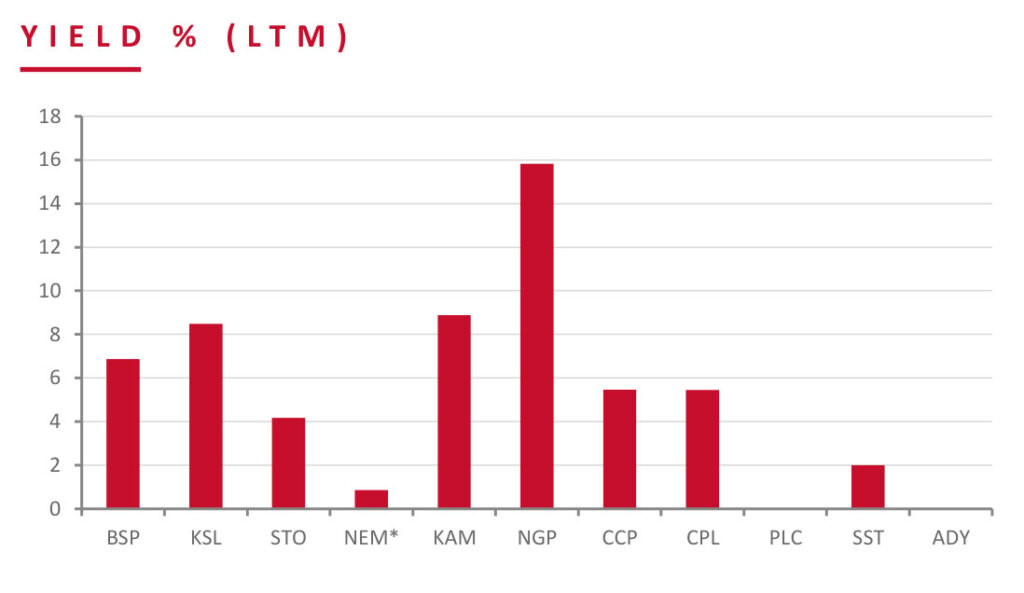
LTM = Last twelve months. Yields use most recently declared interim and final dividends. NEM dividends in USD until PGK rate announced; NEM excluded from market-wide yield. PLC now added.
Dividend Yield = Annual Dividends per Share ÷ Current Share Price × 100
Key Market Announcements
A busier filings week. STO lodged its Third Quarter 2026 report and NEM its Q3 earnings release (Form 8-K and 10-Q) plus a dividend-distribution notice. PLC set out a strategic plan for an integrated industrial precinct and port, and KSL gave notice of the first record date and coupon payment on its KSL361 bonds.
| Stock | Announcement | Source |
|---|---|---|
| STO | Third Quarter 2026 report | View announcement >> |
| NEM | Q3 2026 earnings release (Form 8-K / 10-Q) & dividend-distribution notice | View announcement >> |
| PLC | Strategic plan — integrated industrial precinct & port | View announcement >> |
| KSL | First record date and coupon payment — KSL361 bonds | View announcement >> |
Source: PNGX market announcements, 19–23 October 2026.
BPNG Treasury Bill Auction
Auction: 21-OCT-26 / GOI / Government Treasury Bill | Settlement: 23-OCT-26 | Amount on offer: K250.0m
| Terms | Issue / 63 | Issue / 91 | Issue / 182 | Issue / 273 | Issue / 364 | Total |
|---|---|---|---|---|---|---|
| Weighted Avg Yield | — | — | 4.66% | 5.04% | 5.08% | |
| Amount on Offer (K’m) | — | — | 20.00 | 50.00 | 180.00 | 250.00 |
| Bids Received (K’m) | — | — | 15.90 | 10.13 | 203.90 | 229.93 |
| Successful Bids (K’m) | — | — | 13.90 | 10.13 | 153.90 | 177.93 |
| Over / (Under) Subscribed (K’m) | — | — | −4.10 | −39.87 | +23.90 | −20.07 |
Source: Bank of Papua New Guinea — Domestic Markets Department, T-Bill auction 21 October 2026 (settlement 23 October 2026).
BPNG Government Bond Auction
NO NEW ISSUANCE — WEEK ENDING 23 OCTOBER 2026
Auction: 22-SEP-26 / GOB / Government Bond | Settlement: 25-SEP-26 | Amount on offer: K300.0m
| Series | Offer | Bids | Successful | Yield | Weighted Avg | Coupon | Net Subscription |
|---|---|---|---|---|---|---|---|
| 2026/5057 — 3 yr | 50.00 | 60.00 | 55.00 | 6.17–6.20% | 6.18% | 6.20% | +10.00 |
| 2026/5058 — 5 yr | 50.00 | 66.10 | 66.10 | 6.50–6.60% | 6.57% | 6.57% | +16.10 |
| 2026/5059 — 7 yr | 50.00 | 112.20 | 112.20 | 6.60–6.70% | 6.68% | 6.70% | +62.20 |
| 2026/5060 — 10 yr | 100.00 | 126.54 | 110.54 | 6.70–6.80% | 6.77% | 6.80% | +26.54 |
| 2026/5061 — 15 yr | 50.00 | 56.00 | 50.00 | 7.17–7.20% | 7.18% | 7.20% | +6.00 |
| TOTAL | 300.00 | 420.00 | 393.00 | +120.84 |
Source: Bank of Papua New Guinea — Domestic Markets Department, GOB auction 22 September 2026 (settlement 25 September 2026).
Investor Education: The Securities Regulator
Why markets need a regulator
Securities regulators exist to keep capital markets trustworthy. Worldwide they pursue three core objectives set by IOSCO: protect investors (full, accurate disclosure, shielded from fraud and manipulation); keep markets fair, efficient and transparent (clear rules on trading, licensing and reporting so prices reflect information and everyone plays on the same field); and reduce systemic risk (supervising brokers, clearing and settlement so one participant’s failure doesn’t destabilise the system). In PNG that role falls to the Securities Commission of PNG (SCPNG).
The Commission performs six core functions: licensing and gatekeeping (exchanges, dealers, fund managers and advisers); approving offers and disclosure (prospectuses and information memoranda); market supervision (overseeing trading and participant conduct); enforcement (acting on insider trading, market rigging and misconduct); policy and market development (setting priorities and advising the Minister); and collaboration and AML (working with the Bank of PNG and setting anti-money-laundering policy). It oversees every link — PNGX, brokers like JMP, the depository, fund managers and issuers.
Its mandate rests on PNG’s 2015 securities package, amended in 2023, built on three Acts. The Securities Commission Act establishes the SCPNG as an independent statutory body and converts the old Fidelity Fund into a Capital Market Compensation Fund. The Capital Market Act is the rulebook — licensing, prospectus requirements, bans on insider trading and market rigging, and a takeovers code. The Central Depositories Act underpins clearing, settlement and safe custody. Beyond policing, the regulator is also a builder — bonds, an SME board and local listings show its role in growing the market, not just supervising it.
| 01 | Protect investors Full, accurate disclosure, with investors shielded from fraud, manipulation and misconduct. |
| 02 | Fair & transparent markets Rules for trading, licensing and reporting so prices reflect information and all participants play on the same field. |
| 03 | Licensing & supervision Licenses exchanges, dealers, fund managers and advisers, and oversees their conduct and the market itself. |
| 04 | Enforcement & stability Acts on insider trading and market rigging, and monitors clearing and settlement to contain systemic risk. |
What We’ve Been Reading

FEATURED READ
How anti-avoidance rules are reshaping tax competition
IMF Blog • Beltran Saavedra, Fujii, Kindberg-Hanlon & Ladreit
Highly mobile intangibles — data, patents, software, trademarks — have let multinationals report profits far from where they actually do business, shifting them to low-tax locations, while governments competed by cutting rates and offering incentives. The IMF finds that is now changing. As anti-avoidance rules spread, multinationals increasingly report profits where they invest: reported profits have become less sensitive to tax-rate differences, and real investment more sensitive. Tax competition is shifting from attracting profits to luring the activity that generates them.
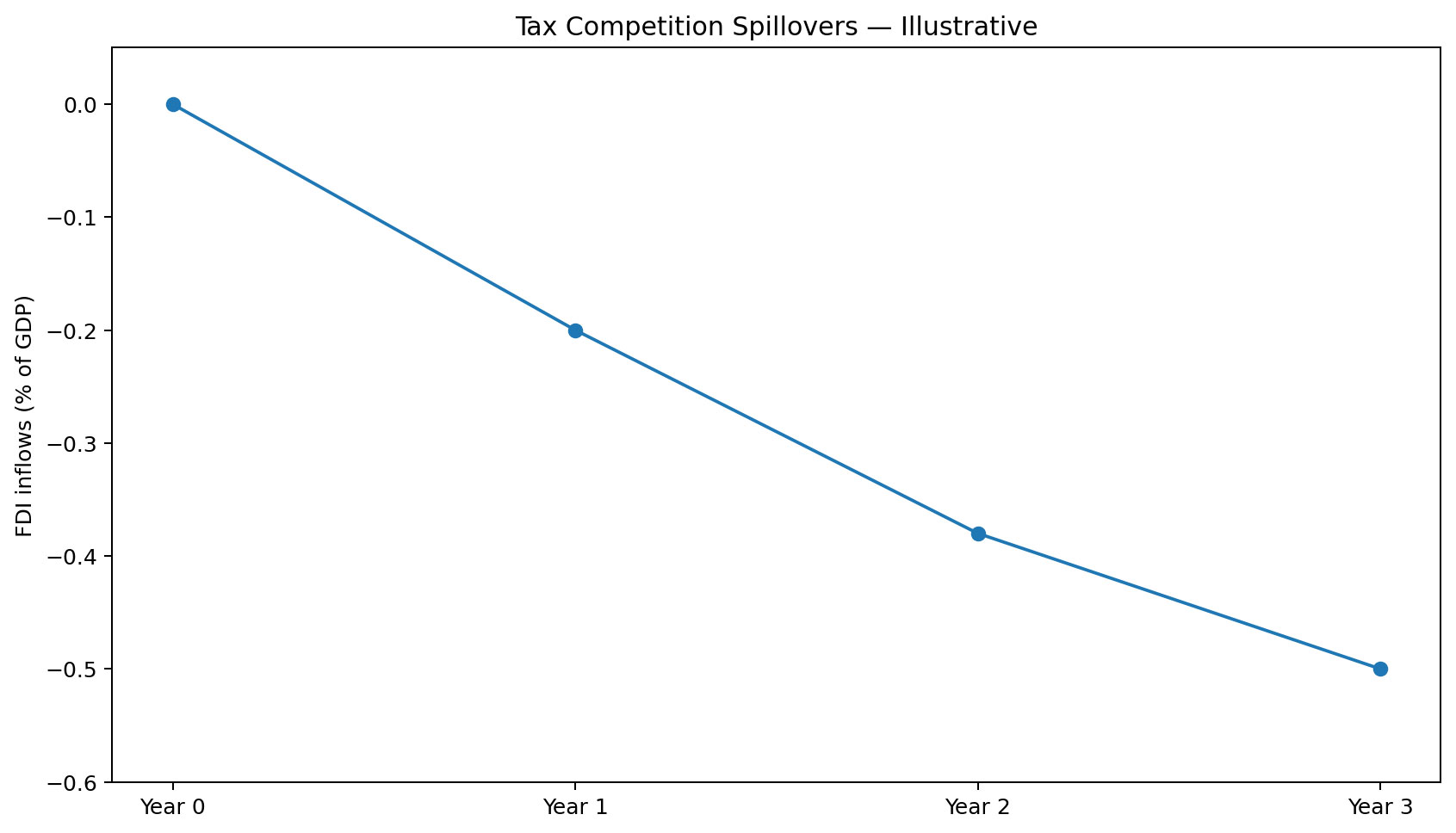
Competition hasn’t vanished, but its character has changed. A 1-point cut in other countries’ headline rates is associated with a 0.4-point cut at home on average — strongest among economies at similar development stages — but since the mid-2010s that headline-rate competition has moderated, alongside stronger anti-base-erosion reforms. The spillovers matter: corporate-tax cuts in major economies are followed by lower output elsewhere (capital reallocation outweighs import demand), and a 1-point rise in a country’s rate relative to others cuts FDI inflows by about 0.5% of GDP over three years.
JMP read: The read-through for PNG sits in the last finding. The IMF stresses that anti-avoidance measures, by limiting profit-shifting, preserve fiscal space — and that the gains are largest for emerging and developing economies that lean heavily on corporate-income-tax revenue to fund infrastructure, health and education. PNG is squarely in that group: a resource economy where protecting the corporate tax base directly supports the budget and the development spending behind long-run growth. The signal is less about chasing headline-rate cuts than collecting the tax genuinely owed.
Figure — Tax Competition Spillovers. Source: IMF (Beltran Saavedra et al.); JMP illustration. Illustrative: a 1pp rise in a country’s corporate tax rate relative to peers is associated with approximately 0.5% of GDP lower FDI inflows cumulatively over three years.
Also on our desk
- Anti-avoidance rules are spreading — multinationals increasingly report profits where they actually invest — IMF.
- Reported profits are now less sensitive to tax rates; real investment more sensitive — IMF.
- Anti-avoidance preserves fiscal space, with the largest gains for emerging and developing economies — IMF.
What this report covered this week
- Weekly trade activity — 5 stocks traded, K4.25m value (−90% pw); a quiet week
- Dividend yields — market-wide LTM 5.28% (flat; KSL firms to 8.48% in commentary)
- STO & NEM Q3 results; PLC strategic plan; KSL bond coupon notice
- BPNG T-Bill auction — under-subscribed by K20.07m
- BPNG bond auction — most recent (no new issuance this week)
- Investor Education — The Securities Regulator (SCPNG)
- External research — IMF on tax-avoidance rules and tax competition
For Further Enquiries
Speak to your equities trader for any orders, research questions or market colour.
Benny Takin
Equities Trader — Primary contact, JMP Weekly Report
benny.takin@jmpmarkets.com
+675 7001 9121 / 320 0240
JMP Securities Limited
Level 3, ADF Haus, Musgrave Street
PO Box 2064, Port Moresby NCD, Papua New Guinea
Disclaimer
This report has been prepared by JMP Securities Limited (Capital Market Licence holder, Securities Commission of PNG). It is general information only and does not take into account the objectives, financial situation or needs of any particular person. It is not an offer or solicitation to buy or sell any security. Information is sourced from PNGX, Bank of Papua New Guinea and external publications cited herein, with JMP analysis. While reasonable care has been taken, no warranty is given as to accuracy or completeness; to the maximum extent permitted by law JMP accepts no liability for loss arising from reliance on this material. Investors should obtain independent professional advice before making any investment decision.